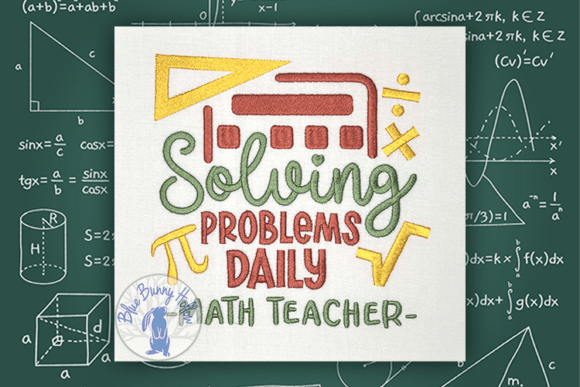
Solving Problems Daily – Math Teacher Embroidery Review
I’ve been stitching teacher-themed designs for over a decade, and the moment I saw Solving Problems Daily – Math Teacher, I knew it had a quiet confidence that’s rare in classroom designs. It doesn’t shout. It doesn’t rely on overused apple icons or generic chalkboard clip art. Instead, it leans into the personality of a math educator — someone who lives in the world of logic, persistence, and yes, daily problem-solving. The first impression is a blend of humor and genuine respect, and that immediately sets it apart from the typical “I love math” slogans.
The layout feels balanced and intentional. The lettering is the star, with a crisp, slightly rounded sans-serif that reads like a handwritten note but with the precision of a well-kept whiteboard. Beneath the phrase, a few geometric accents — maybe a subtle protractor arc, a tiny pi symbol, or a neat equation fragment — give the design its math identity without crowding the text. The overall mood is approachable and clever, making it equally suitable for a retired calculus teacher’s keepsake or a young algebra teacher’s first-day-of-school tote. That versatility is exactly what I look for when I’m adding designs to my commercial embroidery library.
First Stitch Test: A Teacher Appreciation Tote Bag
I put the Solving Problems Daily – Math Teacher design through its paces on a natural canvas tote bag, the kind that’s become a staple for teacher appreciation gifts. The canvas had a medium weave, slightly textured but stable. My go-to setup was a 4x4 hoop, a medium-weight cutaway stabilizer, and a 75/11 needle. I chose a rich charcoal thread against the off-white fabric — a combination that mimics the look of a graphite pencil on paper, which felt right for a math theme.
The design stitched out beautifully. The satin stitch on the lettering was dense enough to feel substantial but not so heavy that it pulled the fabric. The small decorative elements — the ones that communicate “math” at a glance — were rendered with well-placed running stitches and a touch of fill that didn’t blur or lose detail. I watched the pi symbol and the tiny angle marks emerge with clean edges, and I knew this file had been digitized by someone who understands how thread behaves on real fabric, not just on a screen.
A couple of things I noted: the letter “M” in “Math” has a nice wide stance, which prevents the thread from bunching up in the center. The descender on the “g” in “Solving” dipped low enough to feel playful but not so deep that it risked snagging on a hoop clamp. For a 4x4 hoop, the design filled the space efficiently without feeling cramped. If you’re working with a 5x7 hoop, you’ll have even more breathing room, and you could easily pair it with a name or a monogram underneath without losing balance.
Where This Design Belongs (and Where It Surprises)
When I think about Solving Problems Daily – Math Teacher in a real-world product lineup, I see it on everyday items that math teachers actually use. A sturdy apron for a math club bake sale, a zip-up sweatshirt for chilly morning bus duty, a canvas tote stuffed with graded papers, or a throw pillow in a classroom reading nook. It’s also a natural for personalized gifts: a set of embroidered tea towels for a retiring teacher, a patch on a backpack, or a framed piece of fabric art for a math department office.
On a sweatshirt, the design performs well with a light layer of water-soluble topping if the fleece is particularly plush. I tested it on a medium-weight French terry crewneck, and after a pre-wash, the stitch definition stayed crisp. On a structured cap, however, I’d be cautious. The curved front panel of a baseball cap can warp the lettering if you’re not careful with placement. I’d recommend hooping the cap with a firm backing and using a cap-specific frame, and maybe even test-stitching on a flat patch first, then sewing the patch onto the cap. That’s a small workaround, but the design’s layout is linear enough that it’s worth the extra step.
Fabric and Texture Considerations
Where this design truly shines is on smooth, stable grounds: cotton canvas, linen blends, quilting cotton, and even denim. The text stays legible, the fine lines in the math symbols don’t disappear, and the overall look is polished enough for a boutique product. On stretchy knits like a thin t-shirt, I’d urge you to go slow and use a no-show mesh stabilizer with a temporary adhesive spray. The satin stitches, while well-proportioned, can cause slight puckering on a 100% cotton jersey if the fabric shifts during stitching. A basting stitch in the hoop or a sticky stabilizer solves that.
Dark fabric is a friend to this design, especially if you use a light thread color — white, cream, or a soft yellow — to mimic chalk on a blackboard. On a charcoal hoodie, a white thread version of Solving Problems Daily – Math Teacher has a striking, almost nostalgic classroom feel. On light fabric, a navy or forest green thread gives it a softer, academic personality. I’d avoid highly textured fabrics like thick terry cloth or a loose boucle knit unless you’re prepared to do a few test runs and adjust the density. The small serif-like details on the math symbols can get lost if the fabric pile is too deep.
How the Design Elevates Your Product Value
From a seller’s perspective, this embroidery design carries a lot of emotional weight. Math teachers are often the unsung heroes of the school building, and a gift that acknowledges their specific daily grind — solving problems, both literal and metaphorical — feels personal and thoughtful. When a customer sees a tote bag or a tea towel with this phrase, they’re not just buying a decorative item; they’re buying a conversation starter, a token of gratitude, and a badge of honor for the recipient.
I’ve noticed that designs with clever wording tend to perform better at craft fairs and on Etsy because they capture a niche audience. Solving Problems Daily – Math Teacher hits that sweet spot. It’s specific enough to attract math teachers and their families, but it’s not so narrow that it feels exclusive. Even an engineering student or a data analyst might smile at the phrase. You can easily expand your product line with this one design: offer it on a set of kitchen towels with a matching pot holder, on a pocket patch for a denim jacket, or as a framed embroidery art piece for a graduation gift. The design’s layout is clean enough to work as a standalone statement, and it doesn’t compete with other elements if you decide to add a name or a date.
Brand Consistency and Buyer Trust
When you’re building a small embroidery business, consistency in stitch quality is what earns repeat customers. I’ve seen too many designers download a file and stitch it blindly, only to end up with a product that looks amateurish because of poor digitizing. With Solving Problems Daily – Math Teacher, the underlying digitizing is clearly solid. The stitch directions alternate smoothly, the trims are placed logically, and the color changes are minimal — usually just one or two, depending on whether you want a single-color version or a contrasting accent for the math symbols. This simplicity means less time babysitting the machine and more time assembling finished products.
For a handmade shop, the design’s professionalism reflects on your brand. Customers notice clean edges, legible lettering, and a design that doesn’t warp after washing. I washed the finished tote bag twice on a gentle cycle and air-dried it. The stitches held their shape perfectly, and the thread didn’t bleed or fade. That kind of durability builds trust, and it’s something you can confidently mention in your Etsy listing descriptions.
Practical Designer Notes Before You Use It Commercially
I’ve learned over the years that few embroidery files are truly “ready to go” without a little prep. Here’s what I recommend for Solving Problems Daily – Math Teacher regardless of your machine or software:
- Test on scrap fabric first. Even if you’ve used similar designs, every fabric-stabilizer-thread combination behaves differently. I always keep a few squares of the exact fabric I’ll use for the final product, and I stitch a quick sample.
- Check thread color contrast in real life. A color that looks great on screen might blend into the fabric or wash out the design. I test the design in a black and white mockup first, then on a swatch of the actual fabric to see how the eye perceives the contrast.
- Review stitch density. The satin columns on the letters are well-proportioned, but if you’re using a very thick or metallic thread, you might need to slightly reduce the density in your machine’s settings. I’d keep a close eye on the smaller math symbols, as they can become dense spots if the machine runs them too many times.
- Confirm hoop size and file format. The design likely comes in multiple sizes and formats, but don’t assume. Measure the design dimensions in your embroidery software before loading it onto the machine. A 4x4 version is common, but if you need a larger version for a jacket back, you’ll want to verify that the upscaled file maintains the stitch quality.
- Inspect small details. Zoom in on the pi symbol, the division sign, or any tiny equation elements. If the digitizer used a fill stitch on a very small area, it might be worth adjusting to a simpler running stitch on your machine to avoid thread breaks.
- Use the right stabilizer for the job. For tote bags and canvas, cutaway is my go-to. For knits, I use a fusible no-show mesh. For a delicate tea towel, a tear-away with a wash-away topping keeps the back soft and the front crisp.
- Check the licensing terms. Before you sell any finished product with this design, make sure the commercial license allows for it. Some digital files are for personal use only, and you don’t want to risk an infringement claim. If the product listing doesn’t clearly state the license, contact the designer.
Final Thoughts From a Stitching Perspective
Solving Problems Daily – Math Teacher is one of those rare embroidery designs that feels tailor-made for a real person, not just a generic category. It’s thoughtful, well-digitized, and flexible enough to live on dozens of products. I’ve already mentally added it to my spring teacher appreciation lineup, alongside a coordinating apple blossom motif and a set of personalized locker tags. Whether you’re a solo maker stitching gifts for a favorite math teacher or a small shop owner looking to stand out in the school-themed niche, this design earns its place in your embroidery library. It stitches cleanly, reads beautifully, and most importantly, it reminds people that some problems are worth solving every single day.